Monday, October 17, 2011

Victoria Falls, Zimbabwe


Since I am behind in my blogging, I am going to try to catch everyone up on the past week of travel. We left Chobe National Park and Botswana the morning after our wonderful day watching the wildlife The next morning, we got up to ride to Zimbabwe, which was only about ten miles away. We packed our gear, had breakfast, and said goodbye to Christel and some of our other fellow campers. The border crossing was no problem; the Botswana side, very professional and easy, and the Zimbabwe side, a little less so. The officers at Immigration in Zimbabwe were quite sure that I was a spy and asked me repeatedly if I was certain that I wasn't there to uncover their national secrets and share them with the US government. They also thought Colin might be a criminal, and laughed when he said he was an attorney, saying they are the worst criminals of all. They had a good time, as did we, and we got our visas (hand written- no automated scanner/printer setup like we've seen elsewhere). When I got back to the bikes to wait for Colin to finish with Customs, a fuel tanker driver asked if I might like to sell him my bike once I tired of riding it. Maybe, if he is in the US in about a year, we might make a deal, I told him. Once we finished at the border, we rode into Zimbabwe on our way to Victoria Falls. 

Since it's one of the seven natural wonders of the world, and since we were so very close, it seemed a tragedy to miss it. The ride to Vic Falls was flat and dry woodlands and not very scenic but for the baboons. There were LOTS of baboons. At one point, they spilled out of a tree, like the did from my barrel of red, plastic monkeys I had as a child. There must have been at least fifty of them, falling, cartwheeling, and leaping out of a single tree and running across the road in front of us. It was a sight!

Tire change at Shoestring Backpackers
We got to the town of Victoria Falls and set up camp on the shady lawn at Shoestring Backpackers. After walking into town to grab some lunch supplies, we pulled the bikes onto the hard driveway to change the rear tires. While we worked on the second tire installation, one of the gardeners (?) came over to (I thought) see what we were doing and learn (?) about changing tires. As I tried to explain what we were doing, he wanted to help by holding wrenches and the wheel in place. After the wheel was back in place, he asked for a tip for providing his assistance. A little befuddled, I gave him a dollar. Zimbabwe is an incredibly poor nation. Several years ago, you may recall that they had rampant, uncontrolled inflation, to the point of issuing fifty trillion dollar notes. The government changed their currency to the US dollar four years ago, and things have stabilized a bit. Food is now more available but very expensive and with little variety, and fuel can be found at about every third gas station. The unemployment rate is somewhere around seventy percent, and people struggle. I don't mind tipping a dollar in this sort of environment, even though we would have been done faster without his help. When we were finished and repacking the tools, an Australian woman came over to check our our rides. 
 
Here is where we met Sue, a Darwinian who had been working in Kenya for an aid organization and was on her way home via Johannesburg with a stop in Vic Falls for a few days. She is very well-traveled, has worked in Africa and the Pacific, and rides a bike at home that she calls her “nifty fifty,” even though it has a 100cc motor. We spent the evening chatting over (not very good) pizza and (very cold) beer, and she has kindly offered to pick us up at the Darwin airport in about ten months if and when we arrive and to put us up in her home. 
 
The next morning, we had a leisurely breakfast of coffee and bread with peanut butter, walked into town to the grocery store for some picnic supplies, and then continued on to see the waterfalls we could hear from a mile away. This grocery run was Colin's introduction to the contrast between Zimbabwe's food situation and every other country we've visited in Africa. He was really taken aback by the lack of variety and the expense of things. We got some cheese, crackers, and fruit for lunch and walked through town to the falls. Along the way, we encountered people begging and others selling souvenirs rather half-heartedly. I'm used to the hard sell tactics of southeast Asia, but here, they just take no for an answer immediately and go away. It's actually pretty sad that people accept no that quickly. 
 
We got to Victoria Falls, paid our entrance fee (30 dollars each! I really hope this is worth it!), and followed the path to the falls. And it was worth the money. The scenery is so unlike everything around the area- it's lush, and verdant, with huge ferns growing everywhere. The spray from the waterfalls is so heavy that it falls from the trees like it's raining. And this is during the dry season! The water level right now is only a tiny fraction of its maximum, and that was a good thing, because if it was higher, you wouldn't be able to see the falls through the mist. The sound is also unbelievable- an incredible, thundering noise. It was really an awe inspiring sight. Colin and I both wondered at what it must have been like to come across the falls for the first time, as David Livingstone did. 
 
After we walked along the falls twice, we headed back into town to get stuff for dinner. Unfortunately, the grocery store closes at 1:00 on Sundays. We did find a “7 until 11” shop around the corner, and from their selection, bought ground beef, some ramen noodles, and a half of a basketball-sized head of cabbage. From this, I made meatball, cabbage, and noodle soup in the communal kitchen at Shoestring. At the same time, one of the male employees was also cooking dinner for some of the staff. He seemed as curious about what I was making as I was about his sausage curry concoction. Since there was no way on earth that we could eat all the cabbage, I asked if he'd like the quarter of a cabbage that I wasn't using. He gratefully accepted it. We ate what we could of the pot of soup (it was better than it sounds, but not my finest culinary experiment) and I offered the same man the rest of the soup. He was again very thankful, and he put it in a container for later. The next morning, I asked if he could use the remainder of our jar of peanut butter, and he actually said, “God bless you, and thank you.” Life is hard for many people here.

Tuesday, October 11, 2011

THIS Is Worth Getting Up Early For!

Since we had a really short ride to Chobe today, we actually slept in and spent a leisurely morning enjoying breakfast along the river and rearranging our duffel bags to make better sense of them. The Namibia-Botswana border was only about 35 miles from Katima Mulilo, so we made it there in no time. After filling out our Namibian exit forms and a getting a few more stamps on our documents, we were on our way across the bridge to Botswana. Before we got to the Immigrations and Customs building, we had to pass the anti-hoof and mouth disease checkpoint, which involved stamping our shoes on a wet rug in a basin and driving our bikes through about a 9-inch deep pool of muddy water (this was officially my second water crossing!). Once we completed our Botswana entry forms, got our passports and Carnet paperwork stamped and signed again, we rode almost immediately into Chobe National Park, where we had to sign in and register our vehicles before we could continue. This is when things got interesting.


Within the first mile of entering Chobe, the welcoming committee appeared. As I did yesterday, I rode, scanning from side to side for animals, and slammed on the brakes to see the elephants eating about 50 feet to the left of the road. Colin came back to see the “elephants in the corner of the room” and we watched them for a few minutes before continuing onward. Maybe five minutes later, we both hit the brakes again, this time, for the giraffes off to the right of the road. And before I even got back up to speed after seeing the giraffes, there were zebras! The number of animals we saw, just on the public road transiting the park was amazing.

Colin and I were both so engrossed in the scenery that we more or less forgot that we needed to refuel until we headed up a hill, and my bike coughed and then, stopped. We pulled off the road to fill the tanks, and at this point we realized that for the first time ever, we were in an area where we were not the biggest predators. We both kept an eye out for anything with big teeth while we worked, but Colin was not at all amused when I called, “here, kitty kitty, come here, puss puss puss,” before we got back on the bikes to ride STOP! ride STOP! and look some more. This went on for the thirty-some odd mile journey to the town of Kasane, where we would camp for the night. When we arrived at the lodge and campgrounds, we set up our tent in the communal campsite and booked a day trip into Chobe National Park for the next day. We spent the rest of the day doing laundry, relaxing in the pool, and giving Colin a much-needed al fresco haircut sitting on the edge of the pavilion in our campsite.
 

The next morning was an early one. Many of you know that I  am not and have never been a morning person, and it has to be something really important for me to get up at 5:00am. We had to meet for a game drive at 5:30am, so we did just that, jumped out of the tent, splashed water on our faces, brushed our teeth, and grabbed the camera and binoculars for the trip. Our ride for the morning was a large, open-sided safari truck, 4WD (of course), and we all piled in for the journey. The sun was just on the rise as we entered the park. Our guide, Richard, stopped to lock the front hubs on the truck before we started down the deep, sandy tracks. Shortly after we entered, we stopped to watch elephants eating in the woods. We drove farther and saw a herd of impalas, then a pile of banded mongooses feverishly digging through the dead leaves and dirt for bugs. Then we drove a little farther and stopped near a kudu carcass, where we actually glimpsed a wild dog for just a moment! Wild dogs are supposedly the most endangered carnivore in Africa, so I feel really fortunate to have seen one at all.

Our progress was slow along the tracks, and Richard stopped anytime anyone asked him to in order to see the wildlife. He was a great guide, telling us the names of animals, about their behaviors, numbers in the park and beyond, and about the scenery.  We drove along a waterhole, where more impalas, water buffaloes, and water bucks fed before riding up a hill and stopping by a tree in full leaf to see a LEOPARD. It had apparently already eaten and was napping, stretched out along a limb. We could see its hind legs hanging lazily, toes pointed down, tail along another branch, front legs stretched out. We watched it barely move through the binoculars (its tail twitched, and its front paws flexed). AMAZING! When everyone in the truck said to proceed, Richard drove on, stopping for impalas, antelope, beautiful birds, including carmine bee-eaters, fish eagles, and all sorts of other creatures. We passed another truck headed out, and the driver told Richard there were lions ahead. So he drove us on, and sure enough, on a small hill up ahead, were four lionesses snoozing in the morning sun. It was incredible! When we rode back, we passed the leopard in the tree and stopped to watch it again since it was climbing to another branch. This time, we saw its face!  Before we left, we passed the kudu carcass again, but now it was nearly stripped dry by the hundred-plus vultures perched in the trees above. We rode back to the campground after about four hours of game viewing and picture taking, totally in awe.


When we got back to the campground, Colin and I had to move our gear and tent to another site, since one of the big safari companies had reserved the spot where we had stayed. So we picked up and moved to the one that was recommended by the security guard who was standing in reception, which was big, empty, and right near the Chobe River's edge. We had coffee, some breakfast, and tried to absorb everything from the morning.  Later that afternoon, a fellow camper named Christel, from Rouen, France, walked over with her uninflatable Thermarest pad to see if we might have a repair suggestion.  We got our sleeping pad repair kit out and glued a patch on the hole she located.  While we stood around chatting, the security guard who recommended the campsite came to see if everything was okay.  We resoundingly said yes, it was great, and thanked him for the advice.  He said it was a nice spot and that on many evenings, hippos and elephants will walk along the river in front of the site.  Since it was just about time for us to meet up again for a boat ride on the Chobe River, we packed our bag with the camera and binoculars again and climbed on the same truck from the morning trip and rode it to the jetty, where we boarded a large pontoon boat. Our guide was again Richard. As we rode, he and the boat's captain told us some of the history of the islands in the middle of the river and about the animals we should see. Soon after we took off, we started seeing elephants out on the islands. And LOTS of birds. And then, hippos. We stopped to look at them all, watching the hippos raise the tops of their heads out of the water to look at us. The captain moved the boat out farther into the river, and we felt and heard something BUMP! on the bottom of the boat. They said it was a hippo. Fearing we'd hit it, the guides told us just how territorial hippos are, and that they actually ram boats and try to flip them when they enter hippo territory. The hippos will then bite the people in the boat, kill them, and leave them to the crocodiles. Feeling happy that we were in a large, stable boat, we continued on, and as Colin and I looked behind the boat, we saw... a hippo rise out of the water like a porpoise with its jaws open wide. WOW! I had no idea they could move like that and cannot believe we were looking in the right place to see it happen! We saw crocodiles lying on the riverbanks in the sun, watching the unsuspecting birds and buffaloes, more impalas, more river bucks, and large herds of a different kind of antelope called a red lweche. 

The sun was setting as we cruised slowly along the river, watching the animals and truly enjoying the whole experience. We rounded a turn in the river and saw huge herds of elephants, on the islands and on the shore. We watched a group of about fifteen elephants of various ages drink at the edge of the water. Through the binoculars, I noticed something very small rolling in the water at the very edge, behind the bigger elephants. It was a tiny baby! I asked Richard how old it was, and he suspected it was only a few days old, which was kind of what I suspected since I could see what looked like umbilical cord.  Richard said that when they're born, they don't know how to use their trunks to drink, so they kneel down to drink with their mouths, which we watched it do.  The herd turned to leave the shore, and as they walked, I could see the mother elephant guiding her baby with her trunk.  It was such a sweet sight!  We also watched as huge adult elephants walk from the shore to the islands. The water is too shallow for them to swim, so when they walk across, you can only see the tops of their heads and backs. As they exit the water, they look like they've been painted for battle with a two-tone black and gray paint job. I was so overwhelmed by everything we'd seen in this one single day that I cried as we rode back to the jetty.


When we got back to the campground, Colin and I had a quiet dinner and tried to process the events of the day. We headed back to our campsite afterward and heard rustling in the grass between us and the river. Sure enough, there were nearly a dozen elephants grazing in the grasses and trees just beyond our campsite. It REALLY doesn't get any better than this. Today was one of the very best days of my entire life!!!!!!!!!!!!!!!!!!!

Sunday, October 9, 2011

Lullaby of Hippo Grunts

 The next morning, Colin changed the oil in both bikes (he was going to do it the day before, but time got away from us, and before we knew it, it was dark). Unfortunately, the beautiful sunshine was accompanied by a dust storm. And between trying to keep the dust out of the fresh oil, the constant licks from the nosy bull-terrier puppy who wanted to “help”, his newly blood-blistered and throbbing thumb, it was a pleasant experience all around. We left town after breakfast and continued northward. I don't understand the wind patterns in Africa, but we again rode into a strong headwind. No matter what direction we go, there's always a headwind!
Traditional homes
The landscape was flat and dusty, with a whole lot of nothing, but shortly after we cruised through a police checkpoint (without issue), we started to see small villages. The buildings were round or square huts with thatched roofs, surrounded by wooden walls. We saw many people tending or herding their animals (goats and longhorn cattle that would largely put any in Texas to shame - they were so beautiful!), carrying water (there are communal boreholes that supply fresh water), and just going about their daily lives along the side of the road. Many people looked at us and waved as we passed, but most of the children, especially the smallest ones, ran toward the road yelling and waving (I loved the double-handed waves best). Our left arms were both exhausted from waving for a solid hour and a half until we got to Rundu! 
Sunset on the Zambezi
In Rundu, we splurged for a room instead of camping, since we planned to make it all the way to Katima Mulilo the next day (about 350 miles). A room would allow us to get up and go early without having to strike camp and repack in the morning. As we parked behind our thatched-roof bungalow overlooking the Zambezi River, Colin noticed that my rear tire was flat. Once we put our bags in the bungalow, we removed my rear wheel to hopefully patch the tube, and I rode into town on Colin's bike to look for dinner. It was nearing dusk as I rode down the main street, watching in my periphery the sun drop in the sky behind a soccer match being played on a dusty field near the river. It was a lovely, hazy picture. I returned from the store with yet another dinner of pies (it's a good thing we both like crust), fruit, and sodas, which we ate on our porch overlooking the Zambezi while the sun finally set for the night. 
 
!
We got up early the next morning to get started on our long day of riding, and Colin checked the results of his first twilight tire patch, which held nicely. So we reinstalled the wheel, cleaned ourselves up, loaded the bikes, and we were on our way. As we rode east of Rundu, the villages changed from round, wooden huts to square, wood and mud huts with thatched roofs, still with wood fences surrounding the compounds. These continued for miles and miles on the outskirts of Rundu. About a third of the way to Katima Mulilo, we entered Bwabwata National Park with its “Warning, Elephants!” signs to add another element of interest to the ride. We saw plenty of elephant poo, and every time we did, I looked more intently for its creator. We both became more and more skeptical of the presence of elephants, thinking that maybe people from the ministry of tourism pepper the roadside with elephant dung in an attempt to lure more tourists to the area. Sadly, we rode all the way through the park and through the checkpoint at its exit without seeing a single pachyderm. 
 
But wait! As we started riding across some marshy wetlands just east of the park, hulking gray mounds appeared, and I slammed on my brakes (fortunately Colin was ahead of me and no one was behind) in my excitement! Elephants! A BUNCH of them! Oh boy oh boy oh BOY was I thrilled! Colin turned around and I pointed and waved at them. I got out the binoculars, and we watched them do what they do for a good twenty minutes before Colin had to drag me away, promising that I will have other opportunities to see elephants and reminding me that we do NOT ride after dark, and if we are going to make it to Katima Mulilo tonight, we must get a move on. Well, it was nearly dark by the time we got to Katima Mulilo. We camped on the grounds of the very swanky Protea Hotel for the night. While Colin again set up the campsite, I rode out to find something for dinner. I needed to hurry since it was about 6:30pm, and most grocery stores in Africa close at 7:00pm. On my way through the gate of the hotel, I asked a guard for directions to the grocery store. He smiled and said, “I will take you there.” I thanked him and said I just needed directions, but he insisted he would take me to the store. He hopped on his bicycle, and I followed him up the sand driveway to the main road and across, to another sand road, then another, then round another sandy turn. It was fully dark by now, and we pulled into the lot in front of a small market, where I searched for anything to put together for a meal. They had pasta but nothing to make sauce from, giant bags of rice and flour, frozen chicken necks, no eggs, but they did have potatoes and...pies! When I exited the store, my guide was waiting for me and apologized if I wasn't able to find what I wanted. I was just happy to find some food of any sort and even happier that he waited to take me back. As he rode, very slowly, he apologized for his lack of speed, but his bicycle rode like it was constantly in hill climb mode. For each rotation of the pedals, the wheels hardly moved. He finally jumped off and ran alongside the bike, yelling to me where to turn while I waited for him to catch up. I rode as slowly as I could so he could keep up, until my headlamp started to dim because the engine wasn't turning fast enough to keep the light bright. We made it back to the hotel, and I thanked him profusely (and tipped him) for his assistance. Colin and I ate our dinner of meat pies and mashed potatoes on the banks of the Zambezi River, listening to the grunting of the hippos somewhere below. It really doesn't get any better that this!  


Swakopmund to Tsumeb, Namibia

I think we both slept the sleep of the dead the previous night. When the alarm went off, I didn't want to move but managed to drag myself out from under the fluffy duvet and into the bathroom to assess my arm in the mirror. Impressed with my bruise, I attempted to raise my arm above my head and was unable to do so. BUT, you don't need to ride with your arm up unless you ride a chopper with ape hangers, so I was good to go. Colin and I discussed our possible routes last night and decided toward the Caprivi Strip, which is the farthest northeastern portion of Namibia and leads to Botswana and to Victoria Falls.

Today, we rode through central Namibia, making our way to Otjiwarongo for the night. The route took us into several small, dusty towns that looked like what I imagined rural African towns would: small, single-story buildings with fading and sometimes crumbling stucco exteriors, dusty gravel main streets, old advertising signage, bougainvillea and jacaranda, people strolling or sitting, watching the occasional traffic pass, and children playing in the streets. When we got to Otjiwarongo, it was a larger version of this. We camped in town at Acacia Park (very nice, clean, and cheap), which had its very own flock of helmeted guinea fowl that pecked their way aimlessly back and forth across the grounds. I went to the supermarket to pick up something to cook for dinner (we had boerwors, boiled new potatoes with onions and butter, and carrots) and some eggs for breakfast. As we sat digesting after dinner was eaten and dishes cleaned, the local cats made an appearance. All but one were very nervous, the bold one actually came over and let me pet him. We told them they were unfortunately too late for dinner, but if they came back in the morning, we'd make them some eggs. 
 
We went to bed, and in the morning, sure enough, the bold cat sat at the edge of our campsite, meowing for an invitation to breakfast. I gave him some scrambled eggs (as we promised), which he devoured once they cooled. As we ate, the cats arrived, one at a time, and we put down more eggs for them (we both could stand to miss a meal or two, so the cats enjoyed their fill). Since we had a short ride to our destination, it was a relaxed morning and we took our time getting ready to leave. While we drank our coffee, one of the cats decided we were safe and jumped onto the braai to help himself to the remaining butter. We laughed as he and another cat tried to figure out what to do with it. 
 
Our next stop was Tsumeb (only about a 3 and ½ hour ride), where we hoped to find some internet access to catch up on blog posts and ride reports and maybe do some laundry before moving on to Caprivi. We camped at a site recommended in the Lonely Planet guide that was supposed to have internet, but alas, no. We did splurge and have our laundry done in a real machine (serious luxury!) and spent some time talking with a German man named Yves, who'd been hitchhiking across southern Africa for the past several weeks. We asked where he'd traveled and what the highlights were, and he said his time in Chobe National Park in northern Botswana was some of the very best of all. He gave us the name of a place to camp that offers good game drives and boat trips in the park, so we decided to stop there on our way to Victoria Falls. We spent the rest of the evening relaxing on the outdoor sofas, Colin dictating ride reports while I typed, enjoying a Carling Black Label or two, and then went to bed.

Tuesday, October 4, 2011

I wonder what Namibian sand tastes like?

So, fast forward about two hours from our last meeting at the gas station. We rode north along the coast to Henties Bay, then cut east on a secondary, gravel road. We'd heard from other travelers that the gravel roads here are good, so we figured we'd give it a go. It started out as smooth, packed sand and gravel, but after several miles changed to larger stone and loose, dusty sand in drifts. We'd been riding at a fair clip (about 30-35mph) on the smooth stuff, slowed down for the loose stuff, then picked up speed again once the road surface permitted. It was a nice ride at this point, getting warmer and sunnier, and I started feeling more confident and started to look around. BIG mistake. I had been riding in the packed sand, but drifted into some deep and very loose sand. Before I knew it, my handlebars were swapping from side to side, and then, “FUUUUUUUUU (whump) CK!” The next thing I knew, I lay face down in the sand, with my bike on my legs. I was fully aware of where I was and what happened, but I did not want to open my eyes.

I wiggled all my fingers and toes and took in a breath to replace the one I had just knocked slam out of my chest. Then I cackled maniacally in my helmet. Colin ran up and asked if I was okay because I was just lying there doing nothing, and I said yes. He lifted the bike up so I could get out, I stood up, didn't know what I was doing, so we picked up the bike and Colin directed me to gather all the things that had flown off and were now strewn across the desert, after he again made sure I was alright. The bike was okay, just a couple of bent and scraped parts, no major damage. 

Once the adrenalin started to wear off, and Colin again asked if I was okay, I noticed that my right pinky finger, inside of my right elbow, and my right shoulder all hurt. They all moved fine but with pain, and upon inspection, my elbow is contused (it's a helluva good bruise!). We repacked the bike, Colin straightened out a few parts, and after I again told Colin I was okay, continued on. We went about 15 more miles down this same gravel road before Colin saw that my spare tire had apparently gone walkies without permission (this was actually the SECOND time it went AWOL today. The first time I saw it rolling down the road behind me), so he rode back to try to locate it while I took a break. He came riding back about a half hour later with my tire around his neck. Nice necklace, Fabio. 

Colin pulled out the map to look at our route and realized that we weren't going to make it anywhere near to our destination at the rate we were going. It was then that I suggested, fully aware of just how much Colin hates to backtrack, that we go back to Swakopmund for the night and take the paved road the next day. And that's what we did. We returned to Swakop slowly, riding into a massive, freezing headwind the entire way. When we got into town, we were both frozen and decided that we'd like to sleep indoors tonight. Unfortunately, this being a weekend, most everything was full. We did find a room, slightly over our usual budget, that was a well-needed splurge after a really sucky day. 
 
PS- I am fine. My shoulder works fine, my elbow works fine but is turning a lovely shade of purple, and my pinky is also fine. And Namibian sand tastes like American sand. No need to try it for yourselves.


If I Had a Hammer

Namibian po-po
The next morning we left Mariental after a breakfast of coffee and rusks (very dry bread-like biscuits, they're a staple in the region). Shortly after we crossed the city line, we encountered a police stop. The officer waved us over, asked for our licenses, and one came over to inspect the front of my bike. He paid particular attention to my new replacement for Toilet, and told me I need to move it because it was impeding my headlight. It is too tall and covers the lower half of my headlight, which we knew when we bought it, but we figured that since we aren't riding at night at all, it would be fine. But no. So the officer turned the jerrycan on its side for me (fortunately it was empty) and strapped it on the rack. At the same time, another officer played with Colin's seat pad, holding it up as a breastplate for himself. It was actually pretty funny and no problem, and the officers kindly posed for a photo, and we were on our way. We had a short-ish ride to Windhoek and planned to arrive by about 2pm, get a room or campsite, and have an opportunity to look around the city. The ride was uneventful, the temperature good, and we saw our first hornbill in a tree along the side of the road! 

Ouch!
We made decent time and arrived in the outskirts of Windhoek... and promptly made a wrong turn. Colin was leading the way and made a right turn (across traffic, remember, we are now driving on the left) into the drive to the Windhoek Country Club. I followed... and stopped, about three-quarters of the way across the oncoming lane of traffic. I tried to go, with the bike in gear and it wouldn't move, I shifted into neutral, it wouldn't move. So there I was, stuck in traffic (they fortunately had enough space to go around me), with Colin asking me what was wrong. “It won't go,” I told him, so he ran out, tried himself to make it move, quickly gave up on that, and lifted the rear wheel off the ground to wheelbarrow the bike and myself out of the road. It's a good thing the bike weigh less than 200 lbs. Now parked in the entrance to the Country Club, Colin looked at the brakes to see if one was frozen... no. Next, he noticed the chain cover was mangled and came to the sudden realization that the bolts that came loose on the hub of his sprocket mount when we were in Ohio had backed out on mine. So to answer the question of what would happen if one of the bolts came out while we were riding, the bike just stops. One of the bolts had backed out so far that it caught on a metal tab on the swingarm that holds the chain cover on, and it froze the rear wheel. When we got it disassembled, the bolt looked like an arm with a bent elbow. We put it back together, using loctite on the three remaining bolts, and a nice gentleman who stopped to ask if we needed any help directed us to the nut and bolt store to buy a replacement for the bent one. Needless to say, we didn't actually get settled in Windhoek until much later in the day than planned.

The next day, after we took the hub out and put the shiny new bolt in (and did the same with Colin's bike- this time, with loctite), we spent on a hunt for more tires. We each are carrying a spare rear tire, but the ones we have are not lasting as long as we'd hoped. We want to have a spare spare tire to make sure we can make it all the way across Africa, and since Windhoek is the biggest city in Namibia, we figured it would be the place to look. We did get two new tires, hopefully they are made of hard rubber instead of the licorice that our Michelins are molded from! 
 
Our guesthouse in Windhoek was an interesting establishment. It's recommended in the Lonely Planet guide as a good backpackers' place. They had wifi, a pool, included breakfast, and seemed to be a busy place. What I didn't realize when I looked at the rooms and at the campsites out back (oh, that's kind of cool, they have painted up old VW buses under awnings as installation artwork) was that the employees actually seem to live in the buses. In the mornings it was like watching clowns getting out of the teensy car at the circus when you looked at the buses. The line for the shower was always long, and the hallways were always full of people waiting to use something. Anyway, it was an interesting place, and we did meet some very nice people, both fellow travelers and employees. 
 
Springbok look delicious!
Our next destination was Swakopmund, which is a town on the coast that is supposed to be more German than Germany. We weren't really that interested in the city itself, but it's close to the Namib-Naukluft National Park, which has the Welwitschia Drive and huge lichen fields, among other attractions. We wanted to see the welwitschias, having heard about these amazing and ancient plants (they can live up to 2000 years!!!). We went to the park office to get our permit to drive in the park, only to be told that we cannot take motorbikes into the park. The Namibian park system has a blanket rule that they're not allowed, even though there aren't any lions or other hazardous critters in this particular park. I was told to ask the Warden if we could get an exception, and he said no, but we could drive the part of it that is on public roads. So that's what we did. We didn't see any welwitschias, but we did see springboks, herds of running ostriches, and some amazing scenery. And, we put water on the lichens and watched them bloom. Very cool, but no videos of it. Wouldn't want you to fall asleep at work. Sorry. 

Dune 7 on the way to Walvis Bay
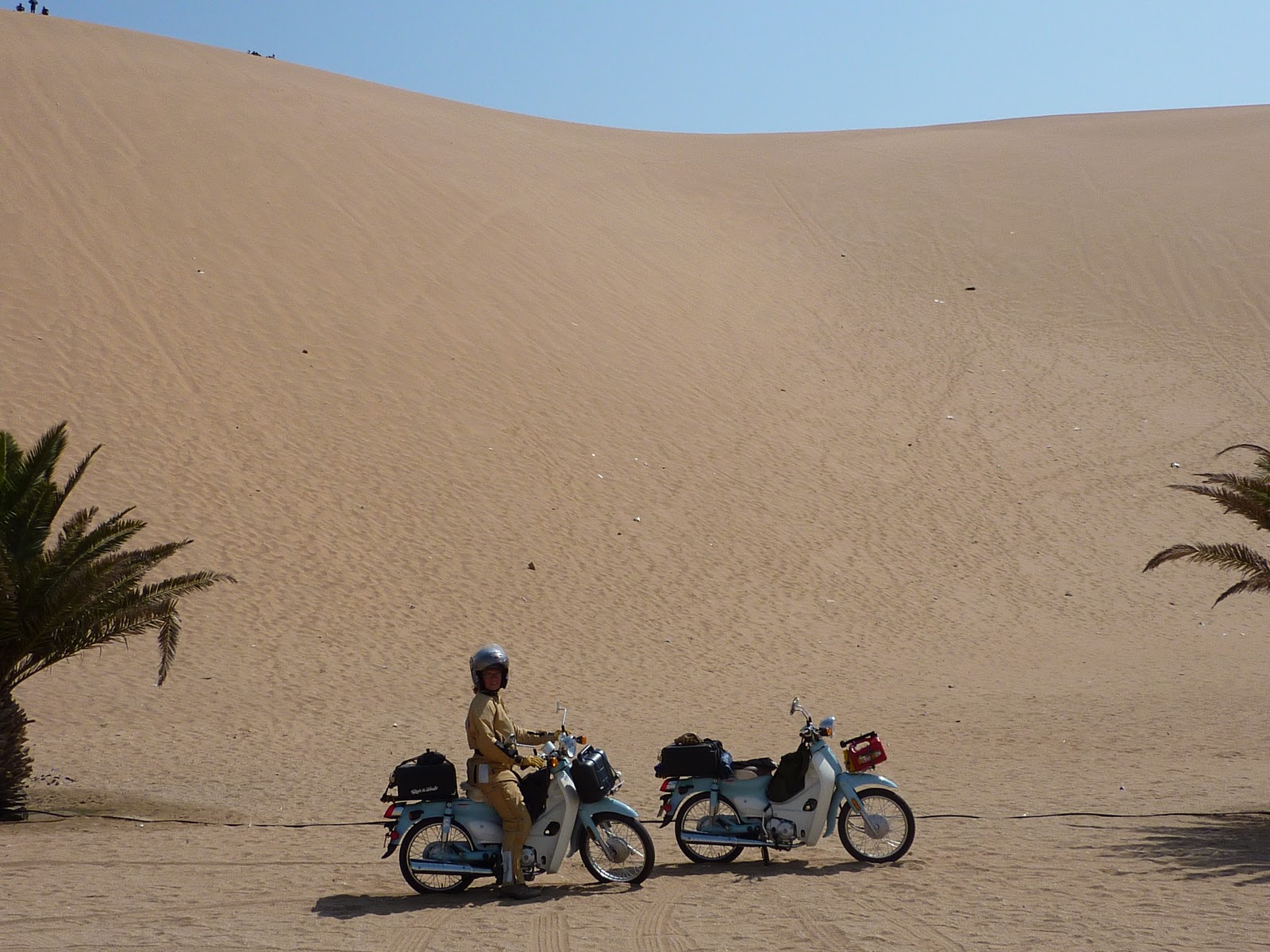
We continued our ride to Walvis Bay along Dune 7, which is a gigantic sand dune, probably several hundred yards high and miles long. It was beautiful to see- the colors of the sand shifted from red to tan to brown in stripes and reminded me of the coats of the springboks we'd seen. On our way back to Swakopmund, we saw TONS of motorcycles riding toward us in the direction of Walvis Bay. Colin remembered that this weekend was bike week in Walvis Bay. Aha, that explains it.

The next day we decided to make our way farther north along the coast, then cut inland to start heading toward Victoria Falls. It rained overnight, was still raining when we got up, and....the power was out all over the city. And, it was cold, so we wanted to get the heck outta there. Our first stop was the gas station to refuel, and while we were at the pumps, a couple of men rode up on their big Africa Twins to talk. They were from near Johannesburg and were riding through Botswana and Namibia before heading back to Jo'burg. As we talked, more riders pulled into the lot, We declined their offers to join their ride, since the weather was crappy and we wanted to keep moving onward, but it was fun to feel like a celebrity for a moment!
To be continued... .

Saturday, October 1, 2011

Na Na Mibia

More of the wildflowers in South Africa
Somehow, even though the wind blew in gusts like an inbound hurricane and kept us from sleeping all night, we still managed to get up an hour late (it helps to turn the alarm to the on position). We rushed around and got on the road only a half hour after we'd intended. We wanted to get an early start since we'd be crossing the border into Namibia and weren't at all sure how long the process would take with our bikes. The ride north to the border was uneventful, the weather was good, the scenery ever-changing, this time from purple and chartreuse plant life to big round boulders to an otherworldly hazy landscape. 

Colin fishing out all of our documents before the border
We made it to the border, and there was no line! So we followed the officers' instructions, went to customs and immigrations and got the appropriate stamps on all our paperwork and passports, and then we had to stop for one final inspection of everything by the South African police. Constable August was seated in a folding chair outside his office under an awning, and he smiled and asked for our passports and drivers' licenses. We handed them to him, he looked them over, then asked for our dollars. We had not a clue what dollars he was referring to, and I'm sure we both looked confused, but he laughed and told us some story out of the rag newspaper he was reading about some thugs who conned a Nigerian moneychanger with fake US dollars. He thought it was all hilarious, took us into his office so we could read the paper for ourselves, and proceeded to tell us how the Nigerians, among other immigrants to South Africa, are ruining Johannesburg by “turning it into a whorehouse- just gambling and prostitution.” Once again, a routine encounter became an entertaining experience with the locals. And then we were off across the bridge and into Namibia. In comparison with the South African process, the Namibian border was decidedly less professional. Things got done, but everything was much more casual: no one came out to verify that our paperwork even matched our bikes! We left the border station and started the ride in Namibia, country number four on this trip. I swear that once we crossed the border, the temperature rose by 10 degrees. Colin and I both have plenty of water with us, but I actually started feeling panicky about the heat (oh my gosh, I'm not sweating! I'm going to die! We need to ration our water, but I'm sooooo THIRSTY!!!!) and felt like I was having a hard time breathing. I thought, between the heat and the plagues of grasshoppers that swarmed and covered the road surface entirely, that the apocalypse must be near. But we were both okay and even had water left by the time we stopped for the night. Our destination for the night was Grunau, which was listed on the map as a minor city, so we figured there'd be guesthouses and campgrounds. There was one hotel, which was very expensive, and one set of cottages(also expensive) with a campground that was adjacent to the gas station that is basically the epicenter of Grunau. We opted to camp, and these were some deluxe camping digs! How about your own bathroom with shower, a private braai (bbq) and outdoor sink, and tons of counterspace? We didn't have anything to cook, so we ate dinner in the restaurant (also attached to the gas station), and slept very well in our tent under the stars, serenaded by the humming of the electric fence surrounding our home for the night.
Weaver bird nests, pretty cool?

The next day, we continued to make our way north. The day was again, hot and dry. The road was straight, and for a large portion of the day, we had quite a headwind. There wasn't much traffic on the road (there aren't many cars in Namibia since there aren't many people here, and very few of them can afford a car. We see many people hitch hiking out in the middle of absolutely nowhere, sometimes whole families- it's not something you'd see in the states for sure). I'm constantly surprised by the plants here. For a desert, there sure are a lot of trees, shrubs, and flowers. I know they're all adapted to the lack of water, but there's still quite a variety, and many of them smell really nice. The scenery didn't provide enough distraction from my sore butt. I couldn't figure out why it hurt so much since we aren't riding that many miles, but it's the same as the high speed runs on the interstate- you don't move around, there are no turns, and you just get stuck in one position for the whole time. The only time I moved was when we stopped to refuel. Since the towns are so far apart, the government issue maps list all gas stops along the roads. Unfortunately, one we had been counting on had apparently closed since the printing of the maps. We pulled in to see the covers removed from the fuel pumps and people camping inside and out of the building. Anyway, we made it to our next stop, Mariental, with the fuel light madly blinking. We pulled into the first gas station we saw, and while Colin took care of the refueling, I wandered into the “spare parts” store to see what they had. As it turns out, they had a lovely black 10 liter jerrycan, which has now replaced Toilet on my front rack. From the gas station, we went in search of a room for the night. Mariental is a bigger city than Grunau, and it seems to have an abundance of meat-related businesses. We passed the piggery on the outskirts of town, and didn't even look at the guesthouse next to the abbatoir (the sheep, Clarice!). Instead, we stayed in what was apparently the only room available in town (at Marlene's house, Villa Volla, it was nice, clean, and she did our laundry!) due to a fishing tournament somewhere in the area. I don't understand where you could fish- all the rivers and stream beds are bone dry. It was an interesting town, and I had my first brush with the law: I turned into the grocery store parking lot right in front of the no entry sign, directly in plain view of the local po po. He beeped at me, but no worries, I'm still a free woman.